About the Journal

The Translation Studies: Theory and Practice (TSTP) is a double-blind peer-reviewed  scientific journal published by the Department of Translation Studies of Yerevan State University. It presents original research articles of high standards in all areas of translation. The journal appears in two issues per annum. Papers submitted to the journal should be written in English. The journal is available both in print and online.


Announcements

Special Issue 4 - Call for Papers

2026-04-11

The international scientific journal Translation Studies: Theory and Practice, published by Yerevan State University, is currently inviting submissions for Special Issue 4, which builds on recent developments in the historical study of translation. The issue explores how translations are shaped by the broader conditions in which they are produced, emphasizing that they serve particular purposes, reflect concrete agendas and generate meaning within specific historical contexts.

    Read more about Special Issue 4 - Call for Papers
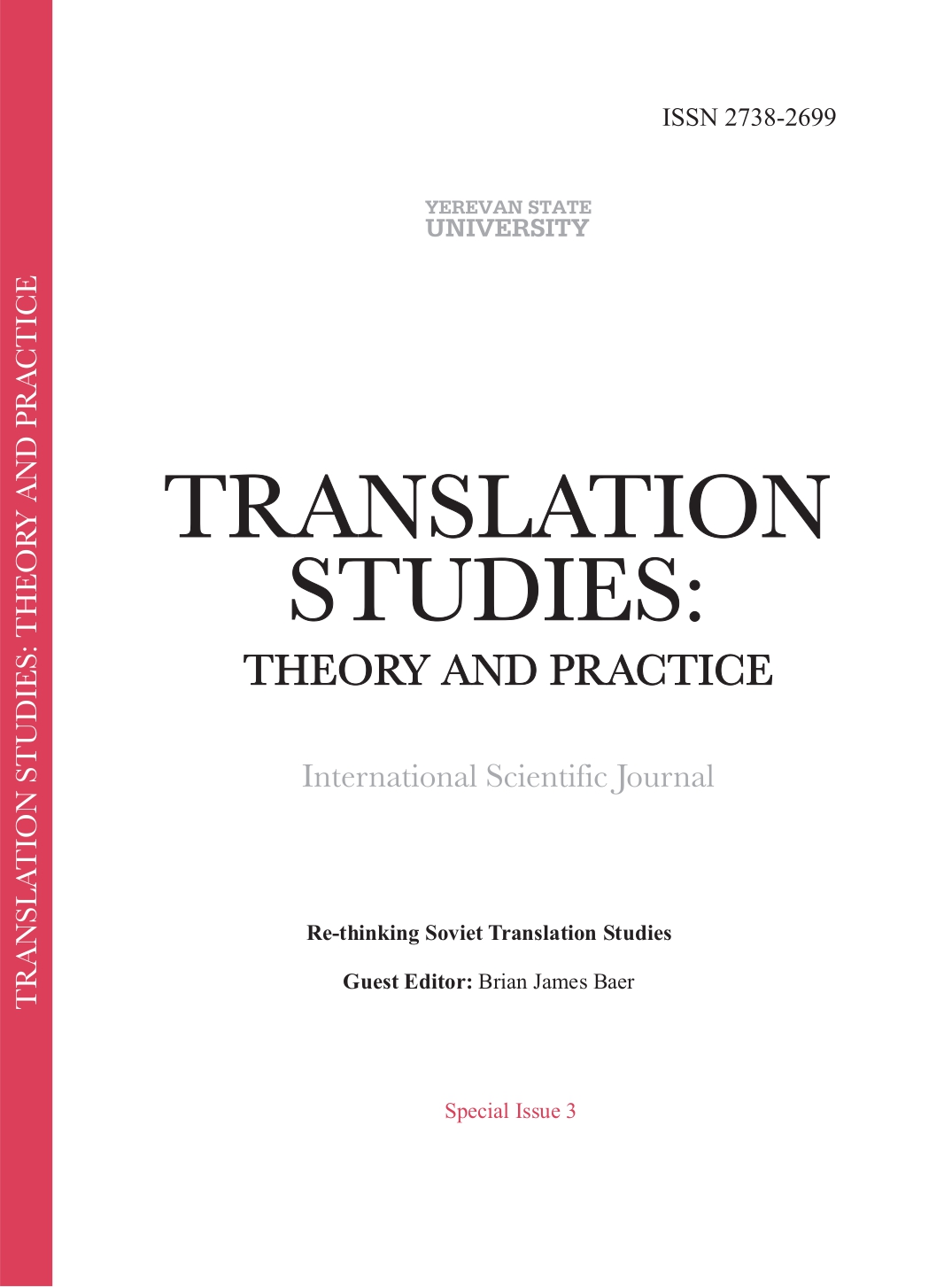
Current Issue

Vol. 5 No. 2(10) (2025)
					View Vol. 5 No. 2(10) (2025)
Published: 2025-12-20

Full Issue

Articles

  • Articles

    Mapping the Dynamics of Translation Studies (2015–2025): A Systematic Bibliometric Analysis

    Abbas Brashi
    View PDF
    Abstract

    This study conducts a comprehensive bibliometric analysis to map the key research trends in translation studies from 2015 to 2025. The dataset comprised journal publications indexed in Scopus and Web of Science. The analysis identified 2021 as the most prolific year. Citation patterns revealed that earlier publications, particularly between 2015 and 2016, had the highest average citation rates, with a gradual decline observed in subsequent years. A sustained scholarly interest in traditional translation models was observed. Emerging areas, such as language processing, cognitive linguistics, artificial intelligence integration, governance, corpus linguistics, healthcare translation, and community interpreting, have gained prominence. Collaborative metrics showed contributions from 7,197 authors across 2,528 documents, indicating a moderate level of scholarly collaboration. The University of London was the most productive institution. The United States ranked first in publication output, followed by the United Kingdom and China. The results provide a systematic overview of the impact and advancements in translation studies, highlighting global patterns and identifying directions for future research.

    References

    Afzaal, Muhammad, Huang, Baorong, and El-Dakhs, Dina Abdel Salam. 2025. “Decoding the Digital: A Corpus-Based Study of Simplifications and Other Translation Universals in Translated Texts.” Frontiers in Psychology 16: 1517107. https://doi.org/10.3389/fpsyg.2025.1517107

    Afzaal, Muhammad, Shanshan, Xiao, and El-Dakhs, Dina Abdel Salam. 2024. “A Comprehensive Bibliometric Analysis of Speech Acts in International Journals (2013–2023).” Cogent Arts & Humanities 11(1): 2380556. https://doi.org/10.1080/23311983.2024.2380556

    Al-Amri, Waleed Bleyhesh. 2025. “Translation Research as Reflection on Translation Practice and Product: The Case of Saudi Arabia.” Journal of Arabic Sciences and Humanities 18(3): 285–300.

    Alangari, Eithar. 2024. “Translation and Interpreting Research in Saudi Arabia: A Bibliometric Analysis (1990–2019).” The Translator 30(2): 210–226. https://doi.org/10.1080/13556509.2023.2200054

    Alshehri, Fawziah Ali, Alshehri, Fadiah Abdullah, Qassem, Mutahar, Bedjaoui, Wafa, and Alfaisal, Asma Ahmed. 2025. “The Dynamics of Translation from and into Arabic in the Arab World: Bibliometric Analysis of the Index Translationum UNESCO Database (1979–2012).” Humanities and Social Sciences Communications 12(1): 1–9. https://doi.org/10.1057/s41599-025-04886-w

    Alyami, Naji, and Qassem, Mutahar. 2024. “Examining Translation and Interpretation Studies in GCC States: Data from Web of Science (1991–2023).” Cogent Arts & Humanities 11(1). https://doi.org/10.1080/23311983.2024.2421083

    An, Gang. 2024. “Domestication and Foreignisation in Translation Studies: A Bibliometric Analysis of WoS Core Journal Articles.” Journal of Intercultural Communication 24(4): 13–22. https://doi.org/10.36923/jicc.v24i4.933

    Aria, Massimo, and Cuccurullo, Corrado. 2017. “Bibliometrix: An R-Tool for Comprehensive Science Mapping Analysis.” Journal of Informetrics 11(4): 959–975. https://doi.org/10.1016/j.joi.2017.08.007

    Chen, Se-Yi., and Wu, June-Tai. 2017. “Global Productivity of Dermatological Research: A Bibliometric Analysis from 1985 to 2014.” British Journal of Dermatology 176(1): 234–236. https://doi.org/10.1111/bjd.14802

    Chen, Xin-Xin, and Chen, Wen-Hao. 2025. “Core Themes and Emerging Trends in International Children’s Literature Research: A Bibliometric Analysis.” Children's Literature in Education: 1–19. https://doi.org/10.1007/s10583-025-09613-2

    Chesterman, Andrew. 2007. “Bridge Concepts in Translation Sociology.” In Constructing a Sociology of Translation, edited by Michaela Wolf and Alexandra Fukari, 171–183. Amsterdam: John Benjamins. https://doi.org/10.1075/btl.74.12che

    Dong, Dahui, and Chen, Meng-Lin. 2015a. “A Bibliometric Analysis of Translation Studies between 1999 and 2014.” Compilation and Translation Review 8(1): 41–82.

    Dong, Dahui, and Chen, Meng-Lin. 2015b. “Publication Trends and Co-Citation Mapping of Translation Studies between 2000 and 2015.” Scientometrics 105(1): 1111–1128. https://doi.org/10.1007/s11192-015-1769-1

    Greńczuk, Andrzej, Tryczyńska, Katarzyna, Sahinguvy, William, Nkunzimana, Hilaire, Ogonowski, Piotr, and Chomiak-Orsa, Iwona. 2025. “Artificial Intelligence as a Tool to Support the Translator’s Work: Bibliometric Analysis.” In Emerging Challenges in Intelligent Management Information Systems. ECAI 2024. Lecture Notes in Networks and Systems, Vol. 1217, edited by Marcin Hernes, Jaroslaw Wątróbski, and Artur Rot, 77–89. Cham: Springer Nature. https://doi.org/10.1007/978-3-031-78465-1_7

    Guo, Gaopan. 2025. “Mapping the Knowledge Domain of Multimodal Translation: A Bibliometric Analysis.” Humanities and Social Sciences Communications 12: 159, 1–10. https://doi.org/10.1057/s41599-025-04510-x

    Halverson, Sandra Louise. 2010. “Cognitive Translation Studies: Developments in Theory and Method.” In Translation and Cognition, edited by Gregory Shreve and Erik Angelone, 349–369. Amsterdam: John Benjamins. https://doi.org/10.1075/ata.xv.18hal

    Hassan, Waseem, and Duarte, Antonia Eliene. 2024. “Bibliometric Analysis: A Few Suggestions.” Current Problems in Cardiology 49(8): 102640. https://doi.org/10.1016/j.cpcardiol.2024.102640

    Hatim, Basil. 2014. Teaching and Researching Translation. London: Routledge. https://doi.org/10.4324/9781315832906

    He, He, and Xiong, Bing. 2025. “A Bibliometric Analysis of Translator’s Style in Translation Studies: A Chinese Perspective (1980–2022).” SAGE Open 15(1): 1–26. https://doi.org/10.1177/21582440251322591

    Hernández, Daniel Gallego, and Díez, Alba López. 2025. “Mapping Business Translation Studies on Metaphor: A Bibliometric Analysis.” Hermēneus. Revista de Traducción e Interpretación 26(1): 161–195. https://doi.org/10.24197/her.26.2024.161-195

    Hicks, Diana. 1987. “Limitations of Co-Citation Analysis as a Tool for Science Policy.” Social Studies of Science 17(2): 295–316. https://doi.org/10.1177/030631287017002004

    Holmes, James Stratton. 2000. “The Name and Nature of Translation Studies.” In The Translation Studies Reader, edited by Lawrence Venuti, 172–185. London & New York: Routledge. https://doi.org/10.4324/9780429280641

    Huang, Qin, and Liu, Furong. 2019. “International Translation Studies from 2014 to 2018: A Bibliometric Analysis and Its Implications.” Translation Review 105(1): 34–57. https://doi.org/10.1080/07374836.2019.1664959

    Inghilleri, Moira. 2005. “The Sociology of Bourdieu and the Construction of the ‘Object’ in Translation and Interpreting Studies.” The Translator 11(2): 125–145. https://doi.org/10.1080/13556509.2005.10799195

    Jiménez-Crespo, Miguel A. 2020. “The ‘Technological Turn’ in Translation Studies. Are We There Yet? A Transversal Cross-Disciplinary Approach.” Translation Spaces 9(2): 314–341. https://doi.org/10.1075/ts.19012.jim

    Kwan, Michelle, Jeemi, Zakia, Norman, Richard, and Dantas, Jaya A. R. 2023. “Professional Interpreter Services and the Impact on Hospital Care Outcomes: An Integrative Review of Literature.” International Journal of Environmental Research and Public Health 20(6): 5165. https://doi.org/10.3390/ijerph20065165

    Larivière, Vincent, Archambault, Éric, and Gingras, Yves. 2008. “Long-Term Variations in the Aging of Scientific Literature: From Exponential Growth to Steady-State Science (1900–2004).” Journal of the American Society for Information Science and Technology 59(2): 288–296. https://doi.org/10.1002/asi.20744

    Laviosa, Sara, and González-Davies, María. 2019. “Introduction: A Transdisciplinary Perspective on Translation and Education.” In The Routledge Handbook of Translation and Education, edited by S. Laviosa and M. González-Davies, 1–8. London: Routledge. https://doi.org/10.4324/9780367854850

    Li, Lei, and Liang, Linxin. 2024. “A Bibliometric Analysis of Book Reviews Published in Translation Journals between 2010 and 2021.” Journal of Scholarly Publishing 55(1): 139–163. https://doi.org/10.3138/jsp-2023-0028

    Liang, Linxin, and Xu, Mingwu. 2016. “A Bibliometric Analysis of International Translation Studies: Based on Relevant Data (2009–2013).” Translation Review 94(1): 52–64. https://doi.org/10.1080/07374836.2016.1143427

    Mohsen, Mohammed Ali, Althebi, Sultan, and Albahooth, Mohammed. 2023. “A Scientometric Study of Three Decades of Machine Translation Research: Trending Issues, Hotspot Research, and Co-Citation Analysis.” Cogent Arts & Humanities 10(1): 1–16. https://doi.org/10.1080/23311983.2023.2242620

    Mondragón, Eliana Maritza Barturen, Castro, María del Pilar Quezada, Arellano, María del Pilar Castro, and Castro, Guillermo Alexander Quezada. 2024. “Scientific Production on Legal Translation (1988–2023): A Bibliometric Analysis.” Journal of Educational and Social Research 14(1): 64–76. https://doi.org/10.36941/jesr-2024-0006

    Muñoz Martín, Ricardo. 2021. “Situated Cognition.” In Handbook of Translation Studies: Volume 5, edited by Yves Gambier and Luc van Doorslaer, 207–212. Amsterdam: John Benjamins. https://doi.org/10.1075/hts.5.sit1

    Nzimande, Erick Nkululeko. 2023. “The Evolution of Translation Theory: From Prescriptive to Descriptive Approaches.” In Translatology, Translation and Interpretation: Toward a New Scientific Endeavor, edited by Noury Bakrim, 3–22. London: IntechOpen Ltd. https://doi.org/10.5772/intechopen.1002611

    Olohan, Maeve. 2021. “Post-Editing: A Genealogical Perspective on Translation Practice.” In Empirical Studies in Translation and Discourse, edited by Mario Bisiada, 1–25. Berlin: Language Science Press. https://doi.org/10.5281/zenodo.4450077

    Pan, Feng, and Wu, Xue. 2023. “Mapping Intellectual Structures and Research Trends of Translation Studies: A Bibliometric Analysis from 2007 to 2021.” Perspectives: Studies in Translation Theory and Practice 32(4): 736–757. https://doi.org/10.1080/0907676X.2023.2275750

    Pym, Anthony. 2006. “Globalization and the Politics of Translation Studies.” Meta: Translators’ Journal 51(4): 744–757. https://doi.org/10.7202/014339ar

    Qassem, Mutahar, and AlThebi, Sultan. 2025. “Mapping Saudi Institutions’ Translation and Interpreting Research in the Web of Science and Scopus: A Bibliometrics Approach.” New Voices in Translation Studies 30(1): 128–161. https://doi.org/10.14456/nvts.2025.5

    Qobti, Amer, and Almohaimeed, Sultan. 2024. “Translation Research in the Arabic Language: A Bibliometric Study.” International Journal of Linguistics, Literature & Translation 7(5): 77–88. https://doi.org/10.32996/ijllt.2024.7.5.10

    Rana, Kritika, Aitken, Sarah J., and Chimoriya, Ritesh. 2025. “Interdisciplinary Approaches in Doctoral and Higher Research Education: An Integrative Scoping Review.” Education Sciences 15(1): 72. https://doi.org/10.3390/educsci15010072

    Rong, Guoyang, Chen, Ying, Ma, Feicheng, and Koch, Thorsten. 2025. “40 Years of Interdisciplinary Research: Phases, Origins, and Key Turning Points (1981–2020).” arXiv (preprint). https://doi.org/10.48550/arXiv.2501.05001

    Saldanha, Gabriela, and O’Brien, Sharon. 2014. Research Methodologies in Translation Studies. London & New York: Routledge. https://doi.org/10.4324/9781315760100

    Shormani, Mohammed Q., and Al-Sohbani, Yehia A. 2025. “Artificial Intelligence Contribution to Translation Industry: Looking Back and Forward (1980–2024).” arXiv. https://doi.org/10.48550/arXiv.2411.19855

    Snell-Hornby, Mary. 2006. The Turns of Translation Studies: New Paradigms or Shifting Viewpoints? Amsterdam: John Benjamins Publishing Company. https://doi.org/10.1075/btl.66

    Sun, Sanjun. 2014. “Rethinking Translation Studies.” Translation Spaces 3(1): 167–191. https://doi.org/10.1075/ts.3.08sun

    Syahid, Abdul, and Qodir, Abdul. 2021. “Journal of Language and Linguistic Studies: A Fifteen-Year Bibliometric Quest for a Bigger Impact.” Journal of Language and Linguistic Studies 17(1): 290–314

    Tahamtan, Iman, Safipour Afshar, Askar, and Ahamdzadeh, Khadijeh. 2016. “Factors Affecting Number of Citations: A Comprehensive Review of the Literature.” Scientometrics 107(3): 1195–1225. https://doi.org/10.1007/s11192-016-1889-2

    Tao, Dai, and Eng, Lin Siew. 2024. “Bibliometric Analysis and Visualization of Translation Assessment: Research Theme, Evolution and Hotspots.” Forum for Linguistic Studies 6(2): 2135. https://doi.org/10.59400/FLS.v6i2.2135

    Tymoczko, Maria. 2005. “Trajectories of Research in Translation Studies.” Meta: Translators’ Journal 50(4): 1082–1097. https://doi.org/10.7202/012062ar

    van Eck, Nees Jan, and Waltman, Ludo. 2010. “Software Survey: VOSviewer, a Computer Program for Bibliometric Mapping.” Scientometrics 84(2): 523–538. https://doi.org/10.1007/s11192-009-0146-3

    Wang, Feng (Robin), Humblé, Philippe, and Chen, Wen. 2019. “A Bibliometric Analysis of Translation Studies: A Case Study on Chinese Canon The Journey to the West.” SAGE Open 9(4): 1–13. https://doi.org/10.1177/2158244019894268

    Wang, Jian. 2013. “Citation Time Window Choice for Research Impact Evaluation.” Scientometrics 94(3): 851–872. https://doi.org/10.1007/s11192-012-0775-9

    Wang, Xi, Bo, Zhixia, and Li, Jiashuai. 2025. “A Bibliometric Analysis of Studies on Multimodal Translation: Retrospect and Prospect.” Semiotica 2025(264): 131–155. https://doi.org/10.1515/sem-2023-0073

    Wang, Yu, and Daghigh, Ali Jalalian. 2024. “Two Decades of Audiovisual Translation Studies: A Bibliometric Literature Review.” SAGE Open 14(3): 1–15. https://doi.org/10.1177/21582440241274575

    Wu, Qian, and Xi, Yue. 2024. “A Visualized Bibliometric Analysis of Translation Studies of Mo Yan’s Works Using VOSviewer from 2000 to 2024.” Journal of Linguistics and Communication Studies 3(4): 90–98. https://doi.org/10.56397/JLCS.2024.12.12

    Yang, Jing. 2025. “Advancing the Field: A VOSviewer-Based Analysis of Research Trends in the English Translation of Sandalwood Death.” Cogent Arts & Humanities 12(1): 2447636. https://doi.org/10.1080/23311983.2024.2447636

    Zawacki-Richter, Olaf, Marín, Victoria I., Bond, Melissa, and Gouverneur, Franziska. 2019. “Systematic Review of Research on Artificial Intelligence Applications in Higher Education.” International Journal of Educational Technology in Higher Education 16(39): 1–27. https://doi.org/10.1186/s41239-019-0171-0

    Zhu, Kun, and Guo, Guoliang. 2024. “A Bibliometric Analysis of Translation Studies of Children’s Literature and Its Implications.” Journal of Scientometric Research 13(1): 260–271. https://doi.org/10.5530/jscires.13.1.22

    Zupic, Ivan, and Čater, Tomaž. 2014. “Bibliometric Methods in Management and Organization.” Organizational Research Methods 18(3): 429–472. https://doi.org/10.1177/1094428114562629

  • Articles

    Rendering Movies through the Prism of Eco-Translatology (Based upon the Ukrainian Dubbed Translations of Oppenheimer and Barbie)

    Artur Gudmanian, Andriana Ivanova
    View PDF
    Abstract

    The paper examines eco-translatology in the context of film translation from English into Ukrainian. Its primary aim is to apply an eco-translational approach to audiovisual translation and to identify the linguistic, cultural and communicative shifts that emerge in the process. The study analyzes two of the best-selling films of the 21st century – Oppenheimer by Christopher Nolan and Barbie by Greta Gerwig – along with their Ukrainian dubbed versions. The research employs comparative and quantitative content analysis, culture-oriented and translation-focused methods and draws on the core principle of eco-translatology: the holistic perspective. The findings highlight the interdependence of translation, language, culture, humans and nature as integral elements of a unified process of transferring meaning from the source text to the target text.

    References

    Badenes, Guillermo, and Coisson, Josefina. 2015. “Ecotranslation: A Journey into the Wild through the Road Less Travelled.” European Scientific Journal (ESJ) 11(10): 356–369.

    Cowley, Stephen. 2009. “Distributed Language and Dynamics.” Pragmatics and Cognition 17(3): 495–507.

    Cronin, Michael. 2017. Eco-translation, Translation and Ecology in the Age of the Anthropocene. London and New York: Routledge.

    Diamanti, Laura. 2022. “Eco-Translation։ Raising Ecolinguistic Awareness in Translation.” MediAzoni 34(1): A184–A198. https://doi.org/10.6092/issn.1974-4382/15556

    Dollerup, Cay. 2011. “Eco-translatology in Translation Theory Contexts.” Journal of Eco-Translatology 14(2): 34–40.

    Gerwig, Greta, director. 2023. Barbie. Warner Bros. Pictures.

    Guo, Wenqin. 2025. “Translation of Political Terms from the Perspective of Eco-Translatology.” Open Access Library Journal 12: 1–1. https://doi.org/10.4236/oalib.1112630

    Hodges, Bert, and Fowler, Carol. 2010. “New Affordances for Language: Distributed, Dynamical and Dialogical Speeches.” Echological Psychology 22(4): 239–253.

    Hu, Gengshen. 2004. Approach to Translation as Adaptation and Selection. Wuhan: Hubei Education Press.

    Hu, Gengshen. 2010. “Eco-translatology: Backgrounds and Bases for Its Development.” Foreign Languages Research 27(4): 64–67.

    Hu, Gengshen. 2013. Eco-Translatology: Construction & Interpretation. Beijing: The Commercial Press.

    Hu, Gengshen. 2020. Eco-Translatology: Towards an Eco-Paradigm of Translation Studies. Springer.

    Hu, Gengshen, and Youlan Tao. 2016. “Eco-Translatology: A New Paradigm of Eco-Translation – A Comparative Study on Approaches to Translation Studies.” T&I Review 6: 115–132.

    Lefevere, André. 1992. Translation, Rewriting and the Manipulation of Literary Fame. London and New York: Routledge.

    Mühlhäusler, Peter. 2000. “Language Planning and Language Ecology.” Current Issues in Language Planning 1(3): 306–367.

    Newmark, Peter. 1988. A Textbook of Translation. Prentice Hal.

    Nolan, Christopher, director. 2023. Oppenheimer. Universal Pictures.

    Oxford University Press. Goofball. In Oxford English Dictionary, 3rd ed. Accessed August 5, 2025. https://www.oed.com/view/Entry/79745

    UAKino-Bay. 2024. Oppengeymer [Oppenheimer]. Published April 3, 2024. Accessed July 25, 2025. https://uakino-bay.net/79221-oppengejmer-2023.html

    UAKino-Bay. 2023. Barbi [Barbie]. Published November 25, 2023. Accessed July 10, 2025. https://uakino-bay.net/79268-barbi.html

    Valdeón, Roberto. 2004. “The Challenge of Research in Audiovisual Translation.” Topics in Audiovisual Translation 52(1): 157–169.

    Wang, Jianguo, and Dai, Zuozuo. 2023. “The Influence of Pragmatic Differences between Chinese and English on Subtitle Translation: A Case Study of The Sound of a Dream.” Chinese Translators Journal 45(3): 148–155.

    Weston, Olena. 2022. “Interventional Strategies in the Ukrainian Dubbing of The Simpsons Movie (2007).” Cognitive Sciences 22: 1–12. https://doi.org/10.11649/cs.2499

    Zhou, Zuo. 2018. “The English Translation Strategy of Subtitles in Youth from the Perspective of Ecological Translation Studies.” Journal of Huaihai Institute of Technology (Humanities & Social Sciences) 16(7): 66–68.

  • Articles

    The Fragile Boundary of the Word: Valery Bryusov in Vahan Terian’s Translation

    Meri Hovhannisyan
    View PDF
    Abstract

    This article presents an examination of all the poems by Valery Bryusov, a leading figure of Russian Symbolism, that were translated into Armenian by Vahan Terian, one of Armenia’s most lyrical poets. These translations, spanning over a decade, reveal not only Terian’s deep engagement with Russian Symbolism but also his unique ability to reimagine Bryusov’s poetic world through the lens of Armenian lyric tradition. Rather than offering literal renditions, Terian’s translations preserve the philosophical depth, emotional intensity and symbolic imagery of the original texts while transforming them with new rhythms, cultural references and spiritual tones. Through a close comparative analysis, the study explores how key themes, such as solitude, memory, loss, the metaphysics of time, etc. are reinterpreted poetically. The article argues that Terian functions not merely as a translator but as a poetic co-creator, whose works offer a rare example of artistic dialogue across languages, cultures and systems of symbols.  

    References

    Bryusov, Valery. 1955. Izbrannye sochineniia v dvukh tomakh. T. 2 [Selected Works in Two Volumes. Vol. 2]. Moscow: Goslitizdat.

    Bryusov, Valery. 1975. Sobranie sochinenii v semi tomakh [Collected Works in Seven Volumes]. Moscow: Khudozhestvennaia Literatura.

    Etkind, Efim Grigorevich. 1963. Poeziia i perevod [Poetry and Translation]. Moscow: Sovetskii pisatel.

    Marouzeau, Jules. 1956. “La Traduction.” Cahiers de l’Association internationale des études françaises, № 8. https://doi.org/10.3406/caief.1956.2090

    Popovič, Anton. 1970. “The Concept of ‘Shift of Expression’ in Translation Analysis.” In The Nature of Translation, edited by J. Holmes, F. de Haan, and A. Popovič, 78–87. The Hague: Mouton.

    Rolfe, John Carew. 1913. “Some Temporal Expressions in Suetonius.” Classical Philology 8(1): 1-13. Chicago: The University of Chicago Press.

    Smith, Charles. W. F. 1959. “Fishers of Men: Footnotes on a Gospel Figure.” Harvard Theological Review 52(3): 187-203. UK: Cambridge University Press.

    Sorokin, Yuriy А. 2009. Devyat′ statey o poeticheskom tekste [Nine Articles on the Poetic Text]. Moscow: Institut iazykoznaniia RAN.

    Terian, Vahan. 1973. Erkeri zhoghovatsu. Hator 2 [Collected Works. Vol. 2]. Yerevan, 1973.

    Tytler, Alexander Fraser. 1791. On the Principles of Translation. Edited by Ernest Rhys. London: J. M. Dent & Sons Ltd. New York: E. P. Dutton & Co. Inc. Accessed February 20, 2025. https://bibdig.biblioteca.unesp.br/server/api/core/bitstreams/b6034320-e6e6-4d33-8b2f-1edfd67619e9/content

  • Articles

    Translation of Allusions as a Problem of Cultural Transfer (Based on the Novel Shame by Salman Rushdie)

    Narine Harutyunyan, Armine Khachatryan
    View PDF
    Abstract

    This article examines the translation of allusions as a key problem of cultural transfer within literary texts, focusing on the Armenian and Russian translations of Salman Rushdie’s novel Shame. The analysis is carried out using intertextual, comparative, and linguacultural methods, which allows us to identify the main strategies for conveying intertextual references. Allusion is a multi-faceted stylistic device that involves the activation of phenomenological precedents relating to literature, mythology, the Bible, history and political events. The challenges of translating allusions concerning Indian mythology and the very complicated political and cultural context for Pakistan necessitate more extralinguistic competence on the part of a reader and the translator. It has been established that adequate transmission of allusions is possible only with a comprehensive approach combining linguistic and cultural-historical knowledge. The results can be useful in the theory and practice of translation, as well as in studies of intertextuality and linguacultural studies.

    References

    Baker, Mona. 2018. In Other Words: A Coursebook on Translation. London: Routledge.

    Baldick, Chris. 2008. The Oxford Dictionary of Literary Terms (3rd Edition). New York: Oxford University Press.

    Barthes, Roland. 1989. Izbrannye raboty: Semiotika. Poetika [Selected Works: Semiotics. Poetics]. Moscow: Progress.

    Ben-Porat, Ziva. 1976. “The Poetics of Literary Allusion.” PTL: A Journal for Descriptive Poetics and Theory of Literature 1: 105–128.

    Bloom, Harold. 1975. A Map of Misreading. Oxford: Oxford University Press.

    Britannica. n.d. “Allusion.” Britannica.com. Accessed March 5, 2025. https://www.britannica.com/art/allusion

    Cuddon, John Anthony. 2013. A Dictionary of Literary Terms and Literary Theory, 5th ed. Chichester: Wiley-Blackwell.

    Cushman, Stephen, Greene, Roland (eds.). 2012. Princeton Encyclopedia of Poetry and Poetics. Princeton: Princeton University Press.

    Hylen, Susan. 2005. Allusion and Meaning in John 6. Berlin: De Gruyter.

    Ilyashenko, Tatyana Stepanovna. 2014. “Intertekstual'nost' kak kategoriya khudozhestvennogo diskursa” [Intertextuality as a Category of Artistic Discourse]. Vestnik Moskovskogo universiteta [Vestnik of Moscow University]. Seriya 9. Filologiya 3: 178–185.

    Irwin, William. 2001. What Is an Allusion? Westport, CT: Greenwood Press.

    Iseminger, Gary (ed.). 1992. Intention and Interpretation. Philadelphia: Temple University Press. https://doi.org/10.1111/1540-6245.00026

    Kiose, Maria Ivanovna. 2002. Lingvokognitivnie aspekti alliuzii: na materiale zagolovkov angliyskikh i russkikh zhurnal’nykh statey [Linguistic and Cognitive Aspects of Allusion: Based on the Headlines of English and Russian Journal Articles]. PhD dissertation. Moscow.

    Lennon, Paul. 2004. Allusions in the Press: An Applied Linguistic Study. Berlin: Mouton de Gruyter.

    Leppihalme, Ritva. 1997. Culture Bumps: An Empirical Approach to the Translation of Allusions. Clevedon: Multilingual Matters.

    Meyer, Hermann Henry Ber. 1968. The Poetics of Quotation in the European Novel. Princeton: Princeton University Press.

    Perri, Carmela. 1978. “On Alluding.” Poetics 7 (3): 289–307. Accessed June 11, 2025. https://doi.org/10.1016/0304-422X(78)90030-x

    Rushdie, Salman. 1983. Shame. London: Jonathan Cape.

    Rushdie, Salman. 2000. “In Defense of the Novel, Yet Again.” In Step Across This Line: Collected Nonfiction 1992–2002, 66–74. London: Jonathan Cape.

    Rushdie, Salman. 2020. Amot [Shame]. Translated into Armenian by Lusine Karapetyan. Yerevan: Antares.

    Rushdie, Salman. 2023. Styd [Shame]. Translated into Russian by Igor Bagrov. Moscow: Corpus.

    Taivalkoski-Shilov, Kristiina. 2006. La Tierce Main: Le discours rapporté dans les traductions françaises de Fielding au XVIIIe siècle. Arras: Artois Presses Université.

    Tuhareli, Maya Dmitrievna. 1984. Alluziya v sisteme khudozhestvennogo proizvedeniya [The Allusion in the System of a Literary Work]. PhD diss., Tbilisi. Accessed June 18, 2025. https://cheloveknauka.com/v/215946/d?#?page=1

    Wheeler, Michael. 1979. The Art of Allusion in Victorian Fiction. London: Macmillan.

    Wilpert, Gero von. 1969. Sachwörterbuch der Literatur. 5th ed. Stuttgart: Verlag.

  • Articles

    Analytical Review of the Impact of Martial Law on the Adaptation of English Terminology in Ukraine

    Vitalina Tarasova, Iryna Miroshnychenko, Svitlana Shestakova, Tetiana Chukhno, Anna Maksymova
    View PDF
    Abstract

    Martial Law in Ukraine, initiated due to Russia’s large-scale invasion in 2022, has significantly impacted various aspects of the country’s life, including linguistic processes. In globalisation and active collaboration with international organisations, English is crucial in professional communication, particularly in defense, medical, technical and humanitarian fields. This study aims to review the impact of martial law on the adaptation of English terminology in Ukraine. The methods included structured interviews with students studying English and practising translation, surveys to collect quantitative data on challenges encountered while adapting English military terminology (the study focuses on military texts originating from the United States and the United Kingdom) into Ukrainian and observations of educational sessions. A total of 43 academic works were selected to explore the article’s topic, conduct a comparative educational analysis and delve into translation processes and neology issues. The study involved 45 participants, including 15 students. The results revealed that incorporating English military terminology into Ukrainian has significantly accelerated and acquired new characteristics. The analysis of relevant literature uncovered the peculiarities of translating military terminology from diachronic and synchronic perspectives. The research findings have shown that English military terminology presents significant challenges and complexities in translation, as it serves both an expressive and a referential function. The exotic nature of these borrowed terms indicates connotative intensification, reflecting an ideologically rather than terminologically driven segmentation of extralinguistic reality.

    References

    Aksoy, Özge, and Söylemez, Ayşe Seimin. 2023. “Translation of Neologisms in Science Fiction: The Textual Reality or Unreality of The Target Text.” İstanbul Üniversitesi Çeviribilim Dergisi 18: 107–22. https://doi.org/10.26650/iujts.2023.1255932

    Aliyeva, Gulchohra Babali. 2023. “Language as a Means of Communication and Social Construction: Regarding Forming Our Identity and Shared Culture.” Futurity Philosophy 2(1): 4–13. https://doi.org/10.57125/FP.2023.03.30.01

    Aliyeva, Gulchohra Babali, Hryhoshkina, Yaroslava, Yanenko, Inna, Leleka, Tetiana, and Strashko, Iryna. 2023. “On the Use of English Morphological Neologisms as Linguistic Reflection of War: Translation Aspects.” World Journal of English Language 14(1): 170–7. https://doi.org/10.5430/wjel.v14n1p170

    Bondarenko, Kateryna, and Balan, Svitlana. 2022. “Military Terms in the Modern War Films: Translation Issues.” Scientific Collection «InterConf+» 27(133): 189–206. Accessed October 10, 2024. https://archive.interconf.center/index.php/2709-4685/article/view/1710

    Capstick, Tony. 2020. Language and Migration. London: Routledge. https://doi.org/10.4324/9781351207713

    Danilyan, Oleg G., Dzeban, Oleksandr P., Kalynovskyi, Yurii Y., and Hetman, Yevhen A. 2022. “Historical and Cultural-Mental Origins of Legal Consciousness of the Ukrainian People.” Revista Notas Históricas y Geográficas 28: 346–60. Accessed October 21, 2024. https://revistanotashistoricasygeograficas.cl/carga/wp-content/uploads/2021/11/18-Danilyan-et-al-Notas-Historicas-Enero-Junio-2022.pdf

    Djambian, Caroline, Rossi, Micaela, d’Ippolito, Giada, Poncet, Emrick, and Maret, Pierre. 2024. “New Terminological Approaches for New Heritages and Corpora: The ITinHeritage Project.” In Proceedings of the 3rd International Conference on Multilingual Digital Terminology Today (MDTT 2024), edited by Vezzani, Federica, Di Nunzio, Giorgio Maria, Sánchez Cárdenas, Beatriz, Faber, Pamela, García, M. Cabezas, León Araúz, Pilar, Reimerink, Arianne, and San Martín, Antonio. CEUR Workshop Proceedings. Accessed October 30, 2024. https://hal.univ-grenoble-alpes.fr/hal-04604833/document

    Dolzhich, Elena A., and Dmitrichenkova, Svetlana V. 2020. “Anthroponymic Structure of Academic Discourse.” Humanities & Social Science Reviews 8(4): 315–24. https://doi.org/10.18510/hssr.2020.8432

    Esmail, Rosmin, Hanson, Heather M., Holroyd-Leduc, Jayna, Brown, Sage, Strifler, Lisa, Straus, Sharon E., Niven, Daniel J., and Clement, Fiona M. 2020. “A Scoping Review of Full-Spectrum Knowledge Translation Theories, Models, and Frameworks.” Implementation Science 15(1): 1–14. Accessed November 9, 2024. https://implementationscience.biomedcentral.com/articles/10.1186/s13012-020-0964-5

    Flatman, Robert. 2018. “Terminology, Units and Reporting–How Harmonized Do We Need to Be?” Clinical Chemistry and Laboratory Medicine (CCLM) 57(1): 1–11. https://doi.org/10.1515/cclm-2017-1083

    Haltsova, Viktoriia V., Volodina, Oksana O., Hordieiev, Volodymyr I., Samoshchenko, Igor V., and Orobets, Kostiantyn M. 2024. “Analysis of Criminal Law on Ecocide: A Case Study of War in Ukraine.” Revista Kawsaypacha: Sociedad y Medio Ambiente 14: D-013. https://doi.org/10.18800/kawsaypacha.202402.D013

    Ivanenko, Nadiya, Biletska, Oksana, Hurbanska, Svitlana, Hurbanska, Antonina, and Kochmar, Diana. 2023. “English Language Morphological Neologisms Reflecting the War in Ukraine.” World Journal of English Language 13(5): 432–38. https://doi.org/10.5430/wjel.v13n5p432

    Ivashchenko, Viktoria, and Ivashchenko, Darya. 2023. “Ukrainian Military Terminology in the Conditions of Armed Aggression: Legislative and Media Discourses.” Terminology Science & Research/Terminologie: Science et Recherche 26: 45–67. Accessed November 22, 2024. https://elibrary.kubg.edu.ua/¬id/eprint-/45544/

    Jalilbayli, Oktay B. 2022. “Forecasting the Prospects for Innovative Changes in the Development of Future Linguistic Education for the XXI Century: The Choice of Optimal Strategies.” Futurity Education 2(4): 42–50. https://doi.org/10.57125/FED.2022.25.12.0.4

    Kalynovska, Iryna. 2024. “Translating English Military Terminology on Special Operations Forces into Ukrainian.” In Compassionate ELT: Voices of Resilience and Diversity in a Time of War, 42–43. Lviv: [Publisher not specified]. Accessed November 10, 2024. https://evnuir.vnu.edu.ua/handle/123456789/25128

    Kelly, John. 2023. “A Critical Discourse Analysis of Military-Related Remembrance Rhetoric in UK Sport: Communicating Consent for British Militarism.” Communication & Sport 11(1): 192–212. https://doi.org/10.1177/2167479520971776

    Kernyakevych-Tanasiychuk, Yuliya V., Sezonov, Viktor S., Nychytaylo, Irina M., Savchuk, Marina A., and Tsaryova, Iryna V. 2021. “Problems of Forensic Handwriting Identification in Forensic Examination.” Bulletin of the National Academy of Legal Sciences of Ukraine 28(1): 195–204. Accessed October 17, 2024. https://visnyk.kh.ua/uk/journals/visnik-naprnu-1-2021-r/problemi-kriminalistichnoyi-identifikatsiyi-pocherku-u-sudoviy-ekspertizi

    Klochko, Tetiana, Rossa, Olena, and Babiy, Alla. 2024. “Language Innovations in Shaping Ukraine’s Media Image in the Context of the Russian-Ukrainian War.” Young Scientist 1.1(125.1): 19–23. https://doi.org/10.32839/2304-5809/2024-1.1-125.1-5

    Kozak, Nataliia, Rudynskyi, Oleh., and Kozak, Dmytro. 2024. “Regulatory and Legal Aspects of Military Doctors and Pharmacists Training in Wartime: Continuous Professional Development at the Faculty of Retraining and Advanced Training of the Ukrainian Military Medical Academy.” Ukrainian Journal of Military Medicine 5(3): 30–38. https://doi.org/10.46847/ujmm.2024.3(5)-030

    Krämer, Philipp, Vogl, Ulrike, and Kolehmainen, Leena. 2022. “What Is 'Language Making'?” International Journal of the Sociology of Language 274: 1–27. https://doi.org/10.1515/ijsl-2021-0016

    McIntosh, Janet. 2021. "Language and the Military: Necropolitical Legitimation, Embodied Semiotics, and Ineffable Suffering." Annual Review of Anthropology 50(1): 241–58. https://doi.org/10.1146/annurev-anthro-101819-110258

    Medvid, Olena, Malovana, Nina, and Vashyst, Kateryna. 2022. “Ways of Generating Neologisms in Modern English.” Philological Treatises 14(2): 73–84. Accessed January 10, 2025. https://tractatus.sumdu.edu.ua/index.php/¬journal/-article/view/1043

    Mohamed, Koudded, Samir, Benatallah and Adel, Meddour. 2024. “Translating Military Terminology.” PhD diss., Kasdi Merbah Ouargla University. Accessed February 10, 2025. https://dspace.univ-ouargla.dz/jspui/handle/123456789/36882

    Mosiyevych, Larysa V. 2017. “The Techniques of English-Ukrainian Translation of Military Discourse.” Jazyk a Kultúra 8(29–30): 112–17. Accessed January 9, 2025. http://www.ff.unipo.sk/jak/29-30_2017/Larysa_Vasylivna_Mosiyevych%20_studia.pdf

    Navalna, Maryna, Kostusiak, Nataliia, Levchenko, Tetiana, Oleksenko, Volodymyr, Shyts, Andriy, and Popkova, Oksana. 2022. “Extra-linguistic Factors and Tendencies of Activation of Military Vocabulary in Ukrainian Mass Media.” Ad Alta 12(1): 184–89. Accessed December 12, 2024. https://evnuir.vnu.edu.ua/handle/¬123456789/¬21010

    Nedelcheva, Svetla. 2023. “21st-Century Neologisms–Word-formative Strategies and Adaptation (a Corpus Study of English and Bulgarian).” Cultural Perspectives-Journal for Literary and British Cultural Studies in Romania 28: 187–212. Accessed October 29, 2024. https://www.ceeol.com/search/article-detail?id=1208712

    Ormeno, Monica D., Roh, Yevin, Heller, Mathew, Shields, Elizabeth, Flores-Carrera, Aidith, Greve, Matthew, Hagan, Jarred, Kostrubala, Anastasia, and Onasanya, Natosha. 2020. "Special Concerns in Military Families." Current Psychiatry Reports 22(12): Article 82. https://doi.org/10.1007/s11920-020-01207-7

    Pak, Antonina, Hurbanska, Svitlana, Boiko, Olha, Avramenko, Valentyna, and Katerynych, Petro. 2023. “The Formalized Semantics of Neologisms-Slangisms in the Context of the English Translation of A Military Narrative.” World Journal of English Language 13(6): 537–43. https://doi.org/10.5430/wjel.v13n6p537

    Shahlee, Shakina, and Ahmad, Salawati. 2022. “Morphological Processes of Social Media Neologisms.” Development in Language Studies 2(1): 19–29. Accessed March 5, 2025. https://penerbit.uthm.edu.my/periodicals/index.php/dils/article/-view/7265

    Shevchuk, Oleksandr, Samoshchenko, Igor, Davydenko, Svitlana, Babaieva, Oleksandra, Verhoglyad-Gerasymenko, Olena, and Marochkin, Oleksii. 2024. “European Arrest Warrant and Protection of Human Rights: Problem Questions of Application in Context Practice of the CJEU.” Pakistan Journal of Life & Social Sciences 22(2). https://doi.org/10.57239/PJLSS-2024-22.2.00672

    Struk, Iryna V., Semyhinivska, Tetiana H., and Sitko, Alla V. 2022. “Formation and Translation of Military Terminology.” Scientific Notes of V.I. Vernadsky Taurida National University 33(72): 29–33. Accessed March 29, 2025. https://er.nau.edu.ua/handle/NAU/56357

    Tkach, Alla, and Tkach, Maksym. 2023. “The Word as a Weapon (about Neologisms Being a Linguistic Reflection of the Russia-Ukraine War).” Topical Issues of Social Sciences and History of Medicine 1: 105–08. https://doi.org/10.24061/2411-6181.1.2023.384

    Torppa, Sonja. 2023. “Discourses of Displacement: A Comparative Corpus-Driven Discourse Analysis of Britain’s House of Commons Debates on the Displaced Populations of Syria and Ukraine.” Master’s thesis, Tampere University. Accessed February 20, 2024. https://urn.fi/URN:NBN:fi:tuni-202305065358

    Trach, Yuliia, Tolmach, Marina, Chaikovska, Olena, and Gumeniuk, Tetiana. 2020. “Problems of Cultural Heritage Preservation in the Context of the Armed Conflict Growth.” In Information Technology in Disaster Risk Reduction, edited by Murayama, Yuko, Velev, Dimiter, and Zlateva, Plamena, 31–44. IFIP Advances in Information and Communication Technology 575. Cham: Springer International Publishing. https://doi.org/10.1007/978-3-030-48939-7_4

    Tymoshchuk, Nataliia. 2022. “Translatability of Modern Media English Neologisms.” Scientific Journal of Polonia University 52(3): 112–17. https://doi.org/10.23856/5215

    Yefymenko, Tetiana, Boyko, Oksana, Gudmanian, Artur, Pavlov, Volodymyr, and Velyka, Alina. 2025. “Scientific Analysis of the Productivity of Using AI in Mastering Languages and Interpretation.” Metaverse Basic and Applied Research 4: 178. https://doi.org/10.56294/mr2025178

    Yemelianova, Olena V., and Shkurko, Olena V. 2024. “Features of Translating English-language Military Discourse.” International Humanitarian University Herald. Philology 67: 229–33. Accessed October 5, 2024. https://essuir.sumdu.edu.ua/handle/123456789/97174

    Yuryk, Olha, Holomb, Lyudmyla, Konovalova, Liudmyla, Vivsyannuk, Volodumyr, and Tsekhmister, Yaroslav. 2023. “Assessment of the Impact of Artificial Intelligence Technologies on the Development of Ukrainian Medicine in War Conditions.” International Journal of Chemical and Biochemical Sciences 24(5): 206–11. Accessed January 28, 2025. https://www.iscientific.org/wp-content/uploads/2023/11/26-ijcbs-23-24-5-26-done.pdf

    Zheliaskov, Vasyl, Krasnopolskyi, Volodymyr, Sharhun, Tetiana, Ihnatenko, Victoriia, Hinsirovska, Iryna, and Tymofyeyeva, Oksana. 2020. “The Impact of European Educational Integration on the Process Study of Foreign Languages in Institutions of Higher Education of Ukraine.” Systematic Reviews in Pharmacy 11(10): 147–55. Accessed March 13, 2025. http://rep.btsau.edu.ua/handle/BNAU/6229

View All Issues